
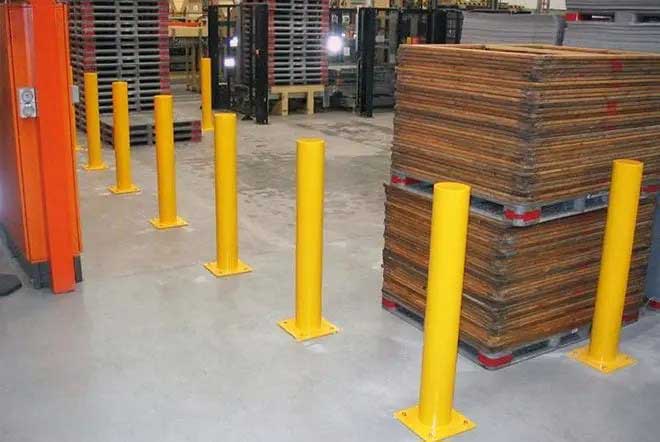
The right bollard for the job depends on what you’re protecting, where it’s located, and how much impact it needs to handle.
The 4 Primary Types of Bollards
Bollards come in a range of styles, but the right choice depends on how much protection the site requires and how people and vehicles move through the space. A solution that works at a storefront or building entrance may not be appropriate for a loading dock, warehouse aisle, or pedestrian plaza.
- Fixed, embedded bollards provide the highest level of impact protection. These are permanently set into concrete and are commonly used to protect storefronts, building corners, overhead doors, and critical infrastructure where vehicle strikes are a real risk. When impact resistance is the priority, this is usually the starting point. For maximum impact resistance, these bollards are set into concrete foundations typically three to four feet deep. That depth distributes force and keeps the bollard in place under real-world impact.
- Removable or retractable bollards are designed for areas that need protection most of the time, but that occasionally require vehicle access. Campuses, service drives, plazas, and emergency access routes often use these systems to balance security with flexibility.
- Surface-mounted bollards are lighter-duty options used in warehouses, parking garages, and retrofit situations where cutting into the slab isn’t feasible. While they don’t offer the same stopping power as embedded systems, they’re effective for guiding traffic and protecting equipment from low-speed impacts, such as forklifts and carts.
- Decorative bollards combine visual appeal with moderate protection. These are often used in streetscapes, retail environments, and hospitality settings where appearance matters as much as function. While they’re not designed for high-speed impacts, they still play an important role in defining space and improving site safety.
Most projects start with one of these categories, then get more specific based on site conditions and risk.
When Custom Makes Sense
While off-the-shelf bollards work well for many standard applications, there are plenty of situations where a catalog option simply isn’t enough.
Custom bollards are often the better choice when a site has specific structural, architectural, or operational requirements. That might mean requiring a thicker wall for repeated forklift traffic, a non-standard height or diameter to match existing conditions, or specialty materials such as stainless steel or galvanized steel for corrosive environments. In other cases, the challenge is the site itself: tight footprints, uneven slabs, existing utilities, or conditions that limit where and how bollards can be anchored.
Aesthetics can also drive the need for custom fabrication. Some projects call for bollards that integrate lighting, signage, decorative sleeves, or finishes that match surrounding architecture, especially in public-facing or mixed-use spaces.
When those variables come into play, custom fabrication allows the bollard to be designed for the real on-site conditions, rather than forcing the site to adapt to a standard product.
Materials, Finishes, and Placement
How a bollard performs over time depends just as much on its material, finish, and placement as it does on its basic design. These choices are what turn a post in the ground into a reliable safety barrier.
Material selection is driven by both impact risk and environment. Steel is commonly used for strong, cost-effective protection in high-traffic areas, while stainless steel is often chosen where corrosion resistance and appearance matter. In higher-impact applications, steel bollards are frequently filled with concrete to increase rigidity and reduce denting, even though the steel itself provides most of the stopping force.
Finishes and coatings play a major role in durability and visibility. Galvanizing and powder coating help protect against corrosion, especially in outdoor environments or areas exposed to road salts and moisture. High-visibility colors and reflective elements improve safety by making bollards easier to see in busy or low-light conditions, reducing the chance of accidental contact in the first place.
Placement and spacing matter just as much as the bollard itself. Posts should generally be no more than five feet apart to prevent vehicle access, while maintaining at least three feet of clearance for ADA-compliant pedestrian passage. Placing bollards too close to the asset they’re protecting can also backfire, as impact gets transferred rather than absorbed.
Case Study: Protecting Warehouse Racks from Forklift Impacts
A local millwork company reached out with concerns about forklift traffic inside their warehouse. Finished goods and pallet storage racks lined multiple aisles, and forklifts regularly moved heavy loads in tight spaces. Over time, those forklifts had begun striking the rack support legs, creating a serious safety risk. A compromised rack holding thousands of pounds of material can fail without warning.
After an on-site review, we fabricated and installed custom surface-mounted bollards positioned to shield the most vulnerable rack supports without interfering with workflow. The bollards were finished in high-visibility safety yellow so operators can spot them clearly, even in low-light conditions.
Designing Bollards That Work in the Real World
Effective bollard systems don’t come from picking a product off a shelf. They come from understanding the site, identifying real risks, and designing a solution that can be fabricated and installed correctly. Decisions around materials, finishes, spacing, and anchoring all affect performance, but only when they’re considered together.
At Macy Industries, we handle bollard projects from start to finish. We start with on-site review and design, fabricate custom bollards in-house, and manage installation to make sure each system performs as intended once it’s in place. Keeping design, fabrication, and installation under one roof reduces guesswork, shortens timelines, and helps avoid the handoff issues that can undermine safety-critical projects.
If you’re planning a bollard installation or trying to solve a specific safety concern, we’re happy to talk through your site and help you determine the right approach.