Eventually, someone says, “We probably need something custom,” and that’s usually when the sticker shock hits. A generic cart from a catalog might run $200, while a rack that’s custom-built to hold 500-pound tooling costs more—sometimes a lot more. That gap throws people off, but it’s important to understand that a catalog cart and a purpose-built tooling rack are not doing the same job. Off-the-shelf storage is designed for general use, not for your specific parts, your workflow, or the way your team actually moves through a cell. Custom storage is built around all of that. It holds what you need it to hold, fits where you need it to fit, and keeps workers from bending, lifting, and searching in ways that slow them down or put them at risk.
At Macy Industries, we design, fabricate, and deliver industrial storage solutions built for the exact conditions on your floor.
Why Generic Cabinets Fail in Industrial Environments
Off-the-shelf storage works fine in light-duty shops or office environments, but those same solutions rarely hold up under heavy industrial use.
Across facilities, we hear the same frustrations from plant managers, facilities teams, and industrial engineers:
Heavy Parts Overwhelm Light Duty Equipment
A lot of tooling components weigh hundreds of pounds. In a recent project, each piece weighed around 500 pounds, and standard cabinets simply aren’t built to support the loading, unloading, and movement of that kind of weight. When storage can’t keep up with what’s being stored, problems cascade from there.
Floor Space Disappears
When storage doesn’t align with workflow, parts end up on pallets or directly on the floor—a situation that wastes valuable square footage and creates trip hazards that safety teams eventually have to address. In addition to custom storage solutions, customers facing these constraints often need custom stairs, platforms, and other structural components to make better use of the space they have.
Workers Waste Time Searching for Tools
The wrong storage solutions often force workers to spend extra time tracking down tools or fixtures, instead of building products. On the surface, the process might not look broken, but the minutes spent searching add up every shift. For high-mix or fast-moving environments, the impact compounds quickly.
Safety Takes the Hit
When workers have to bend, lift, or twist around storage gaps, injuries follow. EHS teams often push for custom storage for the same reason they invest in safety rails and machine guards: it’s easier and cheaper to fix the hazard before someone gets hurt.
How Macy Designs Industrial Storage That Works
At Macy Industries, we start with your problem, not an off-the-shelf product.
Most of our customers don’t need a standard cabinet. They need a rack, cart, or shelving system built around their specific workflow.
We Assess What Your Work Really Needs
Some customers arrive with a rough sketch, while others only know they have parts piling up and need help figuring out what to do about it. Either way, our team begins every job with the same core questions: What are you storing? How heavy is it? How many pieces need storage? Who moves it and how? How much space do you have?
For many projects, we’ll walk your production floor to watch how your team actually works. That upfront understanding is what separates storage that fits your operation from storage that just takes up space.
We Listen to the People Who Use the Equipment
Workers know exactly what slows them down, and those insights often point to details that wouldn’t show up on a spec sheet. One team member might need six extra inches of shelf space to set down a clipboard between tasks. Another might ask for locking casters because equipment tends to get moved around the cell during shift changes. Those requests—whether it’s handle placement, clearance for a specific tool, or a surface to jot down notes—are what shape the final design.
That kind of input leads to solutions like shadow boards, which use foam cutouts to hold every tool for a specific cell so workers can see at a glance whether something’s missing. It also leads to shipping carts that keep twine, banding, markers, snips, and a shrink-wrap torch together in one organized unit, with lanyards so nothing walks off. When the people doing the work help shape these details, the solution fits from day one.
We Build for Strength, Ergonomics, and Efficiency
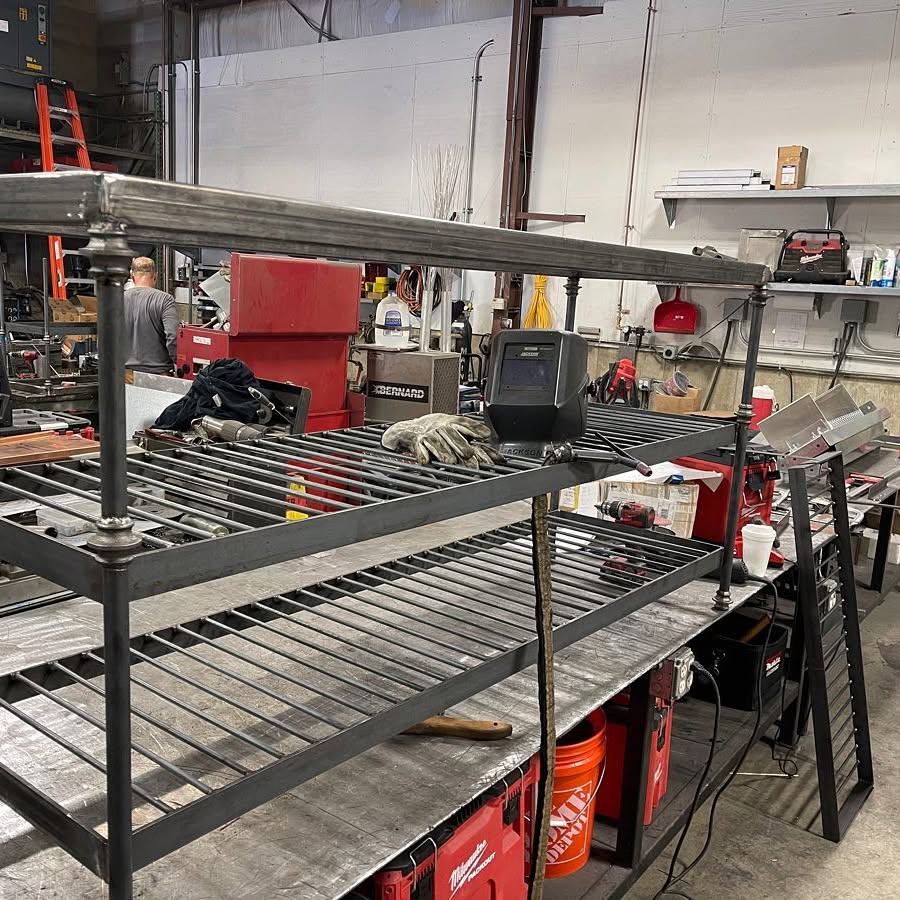
Industrial storage needs strength first. We tend to overbuild—and that’s intentional. If your rack needs to hold 1,000 pounds per shelf, we make sure it holds 1,000 pounds. We fabricate racks from heavy steel tubing, quarter-inch-thick material, and robust welds. That approach lets everyone sleep at night, because the last thing anyone wants is an injury on the floor.
From there, we refine how each component works: setting shelves at a comfortable working height, adding rollers to move heavy tooling easily, providing fork pockets for transport, and sizing wheels for your floor conditions and travel distances. The goal is to store as much as possible without straining the people who use it.
We Choose Materials that Match the Environment
Most industrial racks use steel with paint or powder coating. Harsh or medical environments may call for stainless steel or galvanized finishes instead. The right coating extends service life and resists the daily wear that comes with heavy use.
Case Study: Heavy Tooling Racks for Freudenberg
Freudenberg is a global sealing manufacturer with multiple facilities in New Hampshire that we’ve worked with for more than twenty years. At their Bristol, NH, plant, they needed to increase storage capacity for 500-pound tooling pieces. Their first-generation rack had done its job, but it no longer held enough parts for their current demand.
The project started with an RFQ and reference photos of the existing setup. Our team reviewed the layout, confirmed tooling dimensions, and developed shop drawings. From there, we worked with their team on a few small adjustments before fabrication.
We ultimately built two new racks designed specifically for their load and material flow. Each unit uses heavy steel tubing, precision-cut components, and welded fixtures. We replaced small wheels with full-width rollers for smoother movement and finished each rack in a high-visibility blue coating.
With the updated racks, the Bristol plant can now:
- Store more tooling without expanding its footprint
- Reduce strain during loading and unloading
- Improve organization and safety in the cell
Instead of relying on a catalog cabinet that was never meant to hold this kind of weight, Freudenberg now has purpose-built storage designed around their parts, people, and workflow, all designed, fabricated, and delivered by Macy Industries.
Catalog Storage vs. Custom Storage
| Factor | Catalog Storage | Custom Industrial Storage |
|---|---|---|
| Load capacity | Designed for general use; struggles with heavy tooling and 500 lb+ components | Engineered for your specific weight requirements, with racks built to safely handle known loads |
| Fit | Standard dimensions that may not match your parts or floor layout | Built around your exact footprint, workflow, and part sizes |
| Ergonomics & safety | Workers adapt to the equipment, often bending, reaching, or lifting in awkward ways | Equipment adapts to your workers, minimizing strain and helping EHS reduce everyday injury risks |
| Durability | May sag, bend, or fail under heavy industrial use | Overbuilt with heavy steel tubing, thick material, and robust welds for long-term industrial service |
| Cost | Lower upfront cost, but more likely to be replaced or repaired frequently | Higher upfront investment, but built to last and support your process for the long term |
If you are dealing with heavy tooling, tight floor space, or unique workflows, custom storage usually pays for itself in fewer injuries, less searching, and equipment that does not need to be replaced every few years.
Ready to Rethink Your Storage?
If your storage is sagging under the weight, spreading across the floor, or slowing people down, it is a sign that catalog cabinets and carts have done all they can for you.
You do not have to redesign everything at once. Most customers start with one of three paths:
- Fix a specific storage pain point: Send photos of your current setup or a quick sketch of the parts you need to store. We will help you decide whether a custom rack, cart, or cabinet makes the most sense for your needs.
- Schedule a walkthrough: If storage and safety issues show up in several cells or across a line, we recommend a site visit. This visit gives us a complete picture of your material flow, floor space, and ergonomic constraints so we can design a solution that works across the area, not just in one corner.
- Plan storage into your next upgrade: If you are adding a new cell, line, or renovation, storage should support the layout from day one. Our experience with material handling projects and structural metalwork helps you avoid rework later.
Because we handle design, fabrication, and delivery in-house, what you approve is exactly what shows up on your floor. When you’re ready for storage that handles real weight, saves real time, and fits the way your plant actually runs, talk to the team at Macy Industries.