
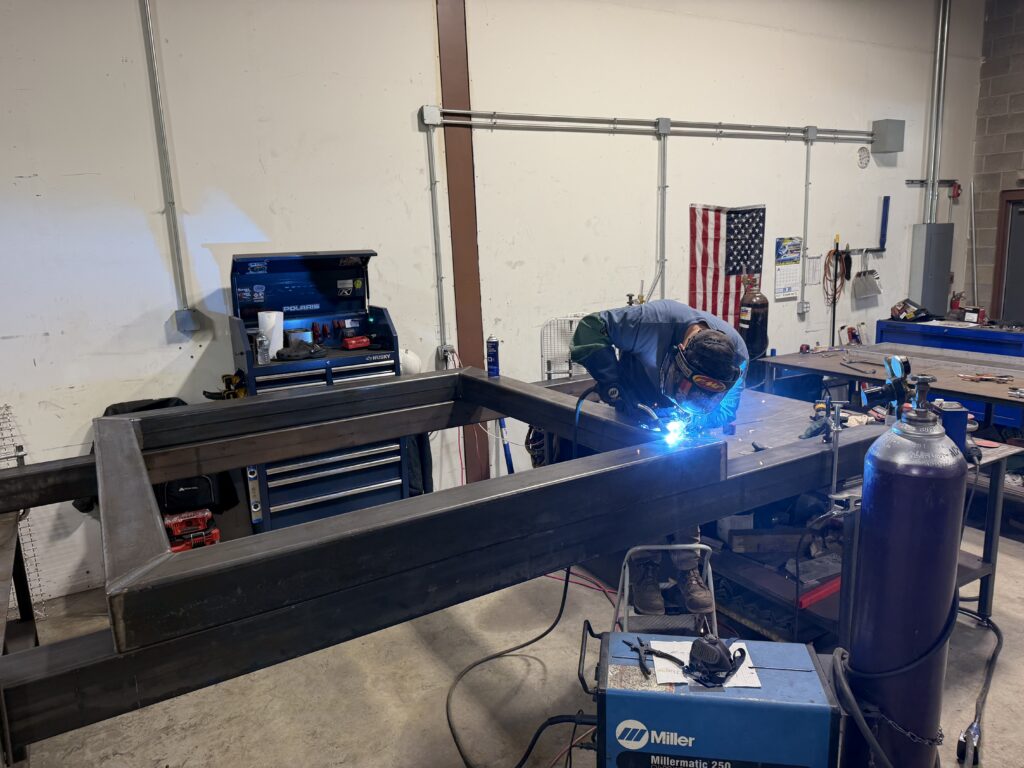
 Many variables go into a custom fabrication quote.
Let’s say, for example, a customer asks for a quote on a metal platform. No matter how many of these our team makes, we can’t just flip through our past project archives to see what we charged last time (wouldn’t that be convenient?). Even when projects look similar, costs and lead times can vary considerably based on the requested material, size, strength requirements, finish, quantity needed, and whether the customer also wants delivery and installation assistance.
As a general rule, the more information we receive in a request-for-quote (RFQ) package, the better. However, there are a few details we consider to be the minimum starting point for all new projects. Together with the available drawings or project details, these give us the foundation we need to begin evaluating the request.
If one of those details is missing, the project can still move forward, but a phone conversation will usually be the next step before we can quote it accurately. That call gives us a chance to learn more about both the project and the person behind it, something that is difficult to do through email alone.
The 4 Essentials Every RFQ Should Include
Before sending your next RFQ, take a few minutes to make sure you have included the following essential details. We also recommend explaining how the finished project will be used. That additional context can help us evaluate whether the specifications match the application and identify possible opportunities to improve the solution.
#1: Material Type
When specifying the type of material for your project, be as specific as possible. Instead of simply saying “aluminum” or “stainless steel,” include the grade or alloy (if required), gauge or thickness, and stock form (sheet, plate, tube, angle, or channel).
The material selection influences raw material cost and availability. It also affects:
- Weight
- Cutting, forming, and welding requirements
- Durability and corrosion resistance
- Whether an additional protective finish is necessary
Material type is actually one of the most common details missing from the RFQs we receive at Macy Industries. If you aren’t sure what material is best for your project, give us a call. Our team is happy to chat through the details.
#2: Finish
If your project has finishing requirements, it’s helpful to have that information up front because finishing can add preparation, processing, handling, and lead time.
There are a few details here that matter: the type of finish and the visual expectations. For example, does your finished product need to be left raw, or should it be painted, powder coated, galvanized, or given another finishing treatment? And are there specific requirements around color, texture, or gloss?
If we don’t have the in-house capabilities to meet your project’s finishing requirements, we’ll work with one of our trusted outside vendors.
#3: Quantity
Quantity significantly affects per-unit cost because programming, machine setup, testing, and other preparatory work must occur whether we produce one unit or ten. With a quantity of one, that single unit carries the full setup cost. With ten units, you can distribute the setup cost across the batch.
Tell us how many pieces you need for the current order. If the project will begin with a prototype or you would like pricing at multiple quantities, include that information as well so we can quote the relevant scenarios.
#4: Lead Time
Provide a required completion or delivery date rather than only saying “as soon as possible.” A real date gives our team the information we need to evaluate material availability, shop capacity, finishing, delivery, and installation requirements. If the schedule is especially tight, tell us that too, and we’ll determine what’s possible.
Together, these details give us a strong starting point for understanding your project’s scope, cost, and timeline. When installation is involved, however, the site itself also becomes part of the quote.
Installed Projects Need Site and Scope Details
If Macy is also responsible for installation, the quote may need to account for field labor, transportation, equipment, site access, sequencing, and coordination with other parties. In addition to the basic project details, provide the site address, exact installation location, known access restrictions, available unloading and staging space, and any work-hour restrictions, shutdown windows, or phasing requirements. Door openings, overhead clearances, stairs, and restricted crane access can all affect how a fabrication must be delivered and installed.
The scope boundaries should also be clear. We need to know what we are responsible for supplying and installing, what the customer or other contractors will complete, and whether we need to coordinate with other trades. These details allow us to plan the installation before fabrication begins and include the right labor and equipment in the quote.
Include CAD Models and Drawings When Available
Once you’ve gathered all the necessary information, it’s time to package it all up. Although we can start wherever you are in the design process, if you’re looking for a quick quote, our preferred starting point is a CAD model and a corresponding PDF drawing with the project specifications and notes.
Both of these documents are important, as they each have a role to play in helping us understand your project:
- The CAD model helps the estimator understand the geometry, dimensions, bends, component relationships, fit, and assembly.
- The PDF drawing communicates requirements that may not be obvious from the model, such as material, thickness, tolerances, welds, finishes, hardware, critical dimensions, and special notes.
We can’t emphasize enough that missing one or even both of these documents isn’t a dealbreaker when you work with our collaborative team. If all you have is a detailed sketch, photograph, or example of an existing item you want to reproduce or replace, send it along with dimensions and as much known context as possible. Our team can start there and help identify what still needs clarification before we finalize the quote.
When Questions Remain, Let’s Talk Them Through
Even a thoughtful, well-organized RFQ may leave some questions unanswered, contain conflicting information, or include decisions that have not yet been finalized. When we need clarification, we typically prefer a quick phone conversation over an extended email chain. This lets us resolve questions in real time while learning more about your priorities, including function, appearance, budget, and schedule.
That conversation may reveal opportunities to simplify fabrication, adjust a noncritical tolerance with your approval, select a more practical material or finish, or improve the installation plan. It also helps us close the remaining gaps and make sure both sides share the same understanding of the project.
A well-prepared quote request reduces assumptions, delays, and the likelihood of requoting. Whether you have all the information up front or need to talk through a few remaining questions, we’re ready to get started. Call us at (603) 623-5568 or submit your project information through our request a quote page.