
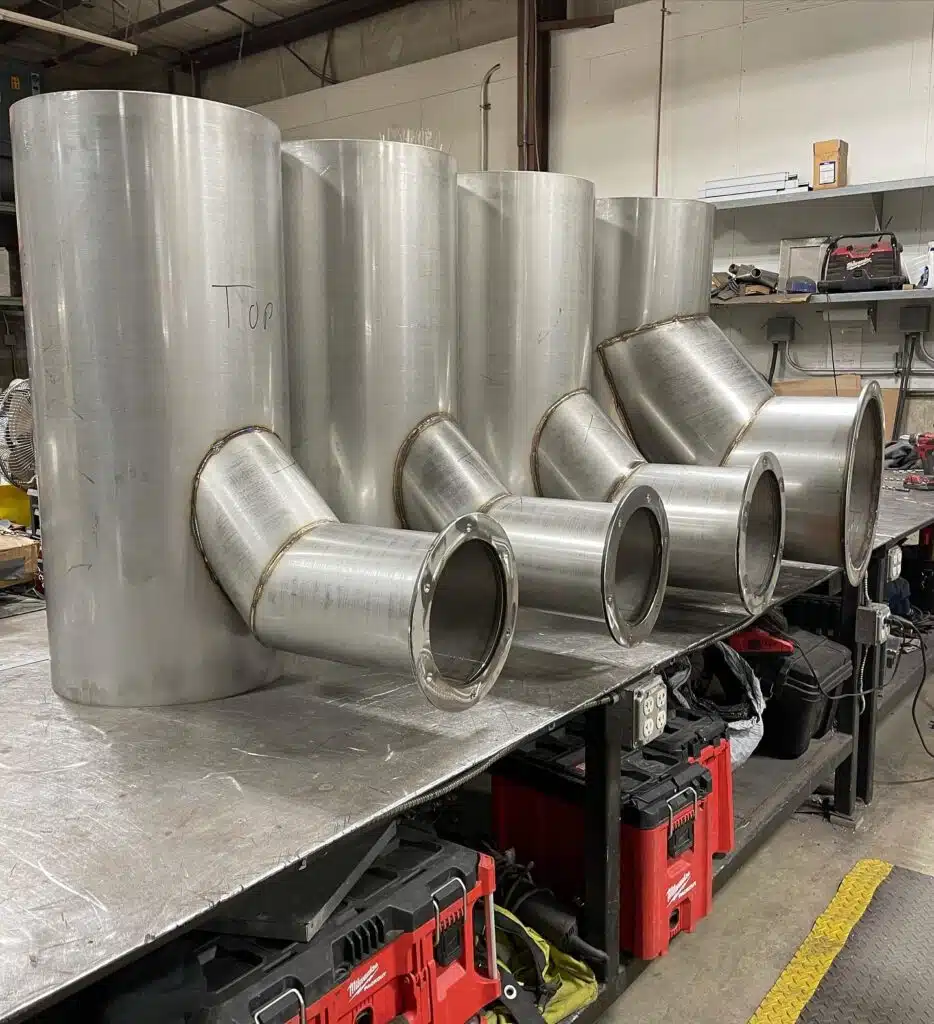
Whether you need sheet metal, plate, or structural steel depends on the part, how thick the metal needs to be, and what it has to handle in the real world. Each choice affects strength, weight, fabrication, cost, and installation.
Metal fabrication terminology can get confusing, especially when sheet metal, plate, and structural steel are all part of the same conversation. But there’s a simple rule of thumb that helps explain the difference: sheet metal forms it, plate strengthens it, and structural steel supports it.
Sheet Metal Forms It
Sheet metal is well-suited for lighter fabricated parts, protective covers, panels, and detailed components because it’s the thinnest and most formable of the three. It’s generally the right choice when a job requires cutting, bending, forming, rolling, or shaping for applications such as:
- Ductwork
- HVAC components
- Enclosures
- Machine covers
- Panels
- Guards
- Light-duty brackets
- Electrical cabinets
Sheet metal is typically specified by gauge and material type. Gauge indicates material thickness, which helps determine how the part can be cut, formed, and used in the final application.
Plate Strengthens It
When strength, durability, load resistance, or reinforcement matter more than formability, plate becomes the better choice. Because it’s thicker and heavier than sheet metal, plate is commonly used for parts such as:
- Base plates
- Gussets
- Wear plates
- Machine components
- Heavy-duty brackets
- Structural connections
- Reinforced mounting points
Plate is usually specified by exact thickness, width, and length, often in fractions or decimals. Those dimensions matter because plate is selected for parts where strength, weight, durability, and fit-up are critical. Because plate work is more strength-focused, fabrication may also involve heavier cutting, drilling, machining, beveling, and welding, depending on how the part will be installed or connected.
Structural Steel Supports It
As its name indicates, structural steel is used to build frameworks and systems that carry loads. Unlike sheet metal or plate, structural steel is not just a thicker flat material. Instead, it refers to steel that is manufactured into load-bearing shapes and assembled into larger structures, such as:
- Beams
- Columns
- Channels
- Angles
- HSS tubing
- Stairs
- Platforms
- Mezzanines
The key difference is function. Structural steel is designed around strength, connections, and load paths, or how weight and force move through a structure. So while plate may be used to reinforce or connect parts of that structure, structural steel is what supports the larger system.
Structural steel is also specified differently. Instead of gauge or flat thickness alone, it is identified by shape and size, such as a beam, angle, channel, or tube. On larger structural jobs, the overall steel package may also be measured and tracked by tonnage.
From there, fabrication may include cutting pieces to length, drilling, fitting, welding, bolting, and assembling components for installation within a larger load-bearing system.
How to Choose the Right Metal for Your Project
It’s a common misconception that because sheet metal and plate are both flat materials, the difference simply comes down to thickness. Thickness is part of it, but there is some overlap. Generally speaking, 11-gauge metal, which is around ⅛ inch thick, is still treated as sheet metal, while material around 3/16 inch and up starts to move into plate territory. At ¼ inch, the line may be less clear, with some materials available as either sheets or plates.
That’s why the better question is not just, “How thick does this need to be?” but “What does this part need to do?”
If a project is designed around sheet metal when it really needs plate or structural steel, the part may flex, crack, wear prematurely, or fail under load. If plate or structural steel is used where sheet metal would have been sufficient, the project may become heavier, more expensive, and more difficult to fabricate or install than necessary.
So while thickness helps define the category, it’s function that drives the final decision.
How Macy Helps Customers Choose
At Macy Industries, we approach every project by first understanding how the part or structure needs to function in the real world. Through this process, we consider factors such as load requirements, intended use, environment, indoor or outdoor exposure, corrosive conditions, installation method, fit-up requirements, and material preferences.
As a collaborative metal fabrication partner, we help customers work through those details upfront. That process may include reviewing drawings and prints, discussing the intended application, looking at photos or sketches, or visiting the site to better understand the project conditions firsthand. The more context we have early in the process, the more easily we can guide the project toward the right material category and fabrication approach.
Whether your project requires sheet metal, plate, structural steel, or any combination of the three, the team at Macy Industries is ready to assist you from start to finish. Contact us or request a quote today to discuss your next project.